Monday, October 2, 2017

Perdido Street Station


Perdido Street Station (Bas-Lag, #1)Perdido Street Station by China Miéville
My rating: 5 of 5 stars

I've read this book twice, several years apart, and both times I was completely absorbed by the world created by Miéville. It's a dark, twisted, and complex world, inhabited by a myriad of races, human and otherwise. The book is part steampunk, part horror, part science fiction, and part just plain weird - but it all works together to create a narrative that draws the reader on. The sheer creativity on display here is breathtaking. Nothing seems trite or overdone, everything feels original - from the creatures who make art by spitting, to the cactus race, to the absolutely horrific nightmare-inducing slake moths. This is not a light read, not a book to cheer you up. It's overarching effect is one of oppression, coupled with a visceral fear. I have been reading for 57 years, and reading SF/Fantasy for probably 50 years, and this is one of the most creative, inventive works I've ever read. I cannot recommend this highly enough! What are you waiting for - go read it!

Saturday, April 15, 2017

Fire Study


Fire Study (Study, #3)Fire Study by Maria V. Snyder
My rating: 3 of 5 stars

2.5 stars
Book 3 in the series. It picks up right where book two left off. You definitely want to read the first two before reading this one. Fans of the first two novels will be very happy with this book.

In this book, Yelena faces her toughest adversary, yet. Not only are the rogue magicians practicing blood magic, they are in league with a spirit (demon?) from the fire realm - the underworld. He is attacking Yelena through fires, and she is unable to protect herself. In addition, the Council of Sitia and the First Magician continue to be suspicious, and outright hostile to Yelena. She has to find a way to conquer the fire spirit, and to combat the increasingly powerful evil magicians. As usual, she manages to do so, but not without many dire encounters that she barely escapes. She has more lives than a cat!

And that brings up one of my complaints - Yelena doesn't seem to change much, despite all she's gone through. Yes, she does grow as a magician, but as a person she remains foolishly headstrong and stubborn. I got a little tired of Yelena rushing headlong into situations, only to have her miraculously rescued, or for her to get out of some situation - yet again - by the skin of her teeth. It got pretty repetitious after three books.

And - my biggest complaint - once again the author is using Earth terms and phrases in a completely made up fantasy world! At one point, when Yelena was reading someone's mind, she sees in his memories that he was "sodomized." Uh, that term comes from the ancient Biblical city of Sodom, and the myth about men raping other men there. On EARTH. In THIS WORLD. There is no way that in the world of Sitia/Ixia that they also just happened to have an ancient city called Sodom, that also just happened to have a myth about male rape. This is just lazy, lazy world building. Additionally, the author uses the term "voila" - the FRENCH term for "ta-da!" But, it gets worse. She can't even spell it correctly; she spelled it "wal-ah." For an author who has an MFA, this is completely inexcusable!!! Lazy world-building PLUS bad spelling!!!

It's a darn good thing that the author is otherwise a pretty good storyteller. Pacing is always good, the story has a good mix of tension and light humor, with just a splash of romance. But any fan of REAL fantasy, who has read the likes of Patrick Rothfuss or George R. R. Martin will be just as irritated as I am with the poor world-building. Readers who just want a fun, diverting semi-fantasy, semi-romance read will not be disappointed.

Friday, April 7, 2017

Magic Study


Magic Study (Study #2)Magic Study by Maria V. Snyder
My rating: 3 of 5 stars

Book two in the "Study" series continues where book one (Poison Study) left off, with Yelena heading to the Magician's Keep in the southern province of Sitia, where she will not only receive training in her magic skills, but she meets her long-lost family. We learn a lot about the different clans in Sitia, some living in the jungle as with Yelena's family, some living on the plains, etc. We also learn that even though the Master Magician, Irys, supports Yelena's training, not all of the other 3 Masters do. Nor does her brother, Leif.

Nevertheless, Yelena begins training, only to be caught up in the hunt for a magical serial killer, preying on young women. Yelena's headstrong nature continually causes her problems with Irys, and the council of Sitia, and it also places her in danger more than once. But, of course, our intrepid heroine always survives. Nevertheless, I appreciated that each time Yelena branched out on her own and got in trouble, there were consequences for her. This helped to mediate the 100% success rate she has.

Naturally, being a romance-tinged fantasy, Yelena's lover, Valek, manages to secrete himself in a delegation from Ixia, and they have many secretive trysts. Not only are they trying to find the serial killer, but the purported heir to the deposed king of Ixia falls for Yelena, which complicates his desires to mount a military campaign against the current Ixian ruler.

All in all, the story moved along well, and the author again does a good job with secondary characters. I thoroughly enjoyed how Yelena was able to communicate with horses, and how her own horse becomes a player in the story. The simple-mindedness of the equine characters seemed fitting, and added a bit of levity to the book.

However - and this is a big however - the author made some really boneheaded errors in other areas, which jarred me out of the fantasy world, and interfered with my overall enjoyment of the book. The problem is the author's use of Earth terms for items that should have Ixian/Sitian names. For example, in one case, a character describes a jacket as having a "mandarin" collar. Uh, "mandarin" refers to Mandarin CHINA, of the real world, Earth. Another example is when Yelena's father, who is an herbalist, discovers a plant extract that causes paralysis - he calls it Curare, which is a real paralyzing poison from plants found in Central/South America. Why in the world would he call it Curare?? In another case, the name of one of the horses is "Rusalka" which is a Slavic name for a water sprite! These are just a few of the times that the author's laziness was a detriment to the verisimilitude of the fantasy world. There really is no excuse for such shoddy world-building.

In all other respects, this is still a fun book. Not deep, nothing too mind-blowing. Just light-hearted escapism, that can be enjoyed as long as you don't look to closely at the details.

Thursday, April 6, 2017

Poison Study


Poison Study (Study #1)Poison Study by Maria V. Snyder
My rating: 3 of 5 stars

3.5 stars

This is the first book in a fantasy series (now up to 6 books) that also has a bit of romance in it. The story follows Yelena, a young woman who was orphaned and who is scheduled to be executed for murder. She gets a stunning reprieve from death if she agrees to become the food taster for the "commander" - a military dictator of the nation of Ixia. She agrees, and begins her training in poisons under the tutelage of Valek, the Commander's chief assassin. Obviously, romance results, but it doesn't feel too forced, and doesn't come too early in the book. The sex scenes are not graphic at all (very G rated), but they are described with some pretty cliche romance notions. The writing is otherwise pretty solid, as is the world-building.

With any first book of a series, we have a lot of history to go through, but the author handles it well, and it flows organically with the plot. We learn that the Commander took over from a corrupt king, and has established a benevolent dictatorship (people are all cared for and employed, but movement is restricted.) The commander has banished all magicians from Ixia, and one of Valek's jobs is to kill any who are found still practicing. This becomes problematic when Yelena discovers she has magical abilities. She has to decide if she can trust Valek in this, and with other things. I thought their slow-building relationship was quite well done.

The action moves along at a good pace, and the characters are well-done - even the secondary ones. This adds some good color to the novel, and keeps the story interesting. All in all, it was a very enjoyable read, and anyone who loves fantasy should enjoy this one.

Sunday, April 2, 2017


The Djinn in the Nightingale's Eye: Five Fairy StoriesThe Djinn in the Nightingale's Eye: Five Fairy Stories by A.S. Byatt
My rating: 2 of 5 stars

This book contains five stories, all in the fairy tale vein. The first four read like your standard fables, and contain nothing really different than one would find in a collection of Grimm stories of Hans Christian Anderson. These stories would be suitable and understandable by kids. The last story, from which the book gets its title, is completely different. It’s set in modern times, and concerns an older woman who is an expert on stories, and what happens when she encounters a djinn (genie) during one of her trips. It’s rather slow to develop, but has some unique ideas. This one is probably not suitable for kids, because it focuses a lot on the woman’s desires as someone in the later years of life. I don’t think children would relate - not that I think this book is aimed at kids, but some people might think so, given the title and the genre.

Overall, I was disappointed in the book. None of the stories grabbed me, emotionally or otherwise. Of all of the stories, I probably liked that last one best, because it seemed to be the most original. But this is not a book I’d read again, or one I’d recommend, unless you’re just totally into fables and/or djinns.

Saturday, April 1, 2017

Smoky


Smoky the Cow HorseSmoky the Cow Horse by Will James
My rating: 2 of 5 stars

This book is basically Black Beauty in the wild west. Like Black Beauty, it follows the life of a horse from birth to “retirement” highlighting the treatment - and abuse - the horse encounters throughout his life. Instead of being set in 19th century England, Smoky takes place in western America, in the early 20th century. But whereas the purpose of Black Beauty was to highlight the mistreatment of horses at that time, Smoky is more of an homage to the rugged American west, where men are men, and they “break” horses to do their bidding.

The titular horse, Smoky, is born to a semi-feral herd of horses, and is spotted by a horse breaker named Clint who works on a cattle ranch. He captures Smoky and begins breaking him to bridle and saddle, and to eventually being ridden. And while Clint is careful to not break Smoky’s spirit (as we are told repeatedly), his breaking methods would make a modern horse trainer cringe. Smoky remains an aggressive, angry horse who will buck off and attack any rider other than Clint. Despite this, Smoky becomes an excellent cow horse, and Clint is the envy of all the other ranch hands.

During the winter months, Smoky is turned loose with the other horses who are not needed to work the ranch, and he ends up being stolen. The thief is described as a “half-breed” and “dark faced” and we are led to believe he is half Native American and half African American. He’s never given a name, and is constantly referred to as “the breed” by the author, and described as a very bad character, with no redeeming qualities. This blatant racism would be completely unacceptable in a book written today. And it really detracted from my enjoyment of the book.

Smoky ends up as a rodeo “bucking bronc” with a reputation as a man-killer. His life with the rodeo is brutally portrayed, and quite painful to read. After he gets too old for the rodeo, he’s sold again, and again, each time ending up more abused and neglected. There’s a semi-happy ending, but the abuse he suffered for half the book pretty much overwhelms that.

I should also mention that the dialog is all done in western slang, much as Twain does with dialects in Tom Sawyer and Huckleberry Finn. This lends some verisimilitude to the story, but tends to wear on the reader after a time - it seems much more artificial than Twain’s usage.

I think I tried to read this as a little girl, when I was totally horse crazy, but I couldn’t get through it - which for a voracious reader who read years beyond her grade level says a lot. I think it was probably a combination of the harsh life depicted for Smoky, along with the dialect.

If you give this to your child to read, be SURE to discuss the racism, as well as explaining that horse trainers today would not do as Clint did. But, honestly, I can’t think of a compelling reason to give this book to anyone.


A Trick of the Light


A Trick of the Light (Chief Inspector Armand Gamache, #7)A Trick of the Light by Louise Penny
My rating: 3 of 5 stars

I read this out of order, and clearly there were events in previous books that played a major role in this one, but the author does a good job of recapping the event (without seeming obvious) so that I didn't feel like I missed out on too much.

The book is another in the fine series, with Inspector Gamache using his mind, and benevolently directing and mentoring his team, to find the murderer of yet another victim in the village of Three Pines in Quebec, Canada. (For such a small, idyllic place, Three Pines has an outrageous number of murders!) The village and its inhabitants are lovingly portrayed, as always; the new characters introduced are well-written and believable; the mystery is tricky enough that it had me guessing until the very end. There are some sub-plots revolving around a major incident in a previous book, which are affecting both Gamache and his second in command, Jean Guy. This adds to the texture of the book, making it more than just a murder mystery.

And that's one of the things that I like about this series - we really get into the head of Gamache, as well as his team. This personal aspect, along with the wonderful, quirky inhabitants of the village make the story much more interesting than just "who done it." Inspector Gamache is a fascinating detective, his humanity really fleshing him out. I like a detective who is imperfect!

Overall, another great addition to a really good series!

Friday, February 10, 2017

The Prince and the Pauper


The Prince and the PauperThe Prince and the Pauper by Samuel L Clemons
My rating: 3 of 5 stars

The Prince and the Pauper

I don’t recall reading this as a child, which is too bad, as I think I would have loved it! I liked stories about knights and such, and while this isn’t specifically about knights, it does take place in “old England” and certainly transports the reader to that time and place.

Most people know the general idea of the story: a young street urchin and a prince (who happen to look alike) end up switching places, each living the life of the other for a few weeks. But maybe, like me, you are a little fuzzy on what exactly happens, and who, specifically, the titular prince is. (For instance, I always thought the swap in position was a deliberate, mutual undertaking - not so.) Clemens places the story at a specific time period, with an actual prince of England, Edward, son of Henry VIII. The author even uses footnotes for citations of actual events or practices of the time. And, as Clemens did with Tom Sawyer and Huckleberry Finn, he uses “dialect” to further immerse the reader into the time and locale of the story. In this case, the dialect is sort of a “King James English” with lots of “thee” and “thou” and the like. All of these things serve to make the story very realistic, even if the events might be a bit hard to swallow.

The story begins with a young boy, Tom Canty, who lives in a shack in Offal Lane. His father is an alcoholic abuser, and Tom lives a pretty rough life, as a result. But a priest took an interest in Tom, and taught him to read, so Tom escapes the cruelty of his real life with a vivid imagination. Tom loves nothing more than to imagine himself as a rich prince, living a life of ease and luxury. He is teased by his peers for this, but not severely so - his friends often join in his games of palace and royalty. Tom’s one goal in life is to see an actual, real life prince, so one day he goes to the palace to see if he can spot one. He runs afoul of one of the palace guards, who starts to beat him. Prince Edward sees this, and rushes out to Tom’s defense. He brings Tom inside, and the boys shyly start to get to know one another. They playfully swap clothes, and laugh at their identical looks. Events transpire that lead the prince to go outside, still in Tom’s clothes, where he is kicked out of the palace by the guard who first accosted Tom - the guard not believing the prince’s protestations as to his true identity. Thus begins the adventure for each boy, as each one learns to live in the strange world of the other.

Clemens doesn’t back off from the depredations and difficulties of being poor at that point in time. While he doesn’t go into details, there are beating, hangings, drunken parties, thieving, and so on. This is no happy-go-lucky poverty - this is the real, soul-crushing poverty, exacerbated by the laws of the time. Edward keeps insisting he is the prince, but, of course, no one believes him. He is befriended by a nobleman down on his luck, who takes pity on the poor “fool” and plays along with his “delusions” so as to not upset him. He hopes that by caring for Edward, he can eventually cure him of his madness. The prince encounters many rough characters, including Tom’s abusive father who is chasing him, thinking he is Tom who has run away. The prince’s eyes are opened as to the injustice of the laws, and vows to rectify this when he is returned to his throne.

We don’t spend quite as much time with Tom, who is attempting to fill the place of the prince. He knows he’s an imposter, but at first feels like he owes the real prince the duty to fill his place as well as possible. Later, Tom begins to really enjoy the life of luxury, and hardly thinks of the prince any more. We see his attempts to act princely, and his mistakes are chalked up to a temporary mental illness, that the palace staff hope he eventually gets over. The staff are all told not to mention Tom’s gaffes, but to gently guide him when he seems lost as to what to do.

Eventually, events transpire to bring Edward back to the palace, and he regains his throne. Tom is cared for financially, the prince (now the king) enacts better laws, and the nobleman who befriended him is restored to his estate. It’s a nice happy ending!

I think that any child would enjoy this book, though the dialect may be a bit hard for them. The depiction of life in poverty would be a good teaching tool. I can imagine lots of good lessons coming from this book, if a parent or teacher were so inclined.

Saturday, February 4, 2017

Forbidden Brides of the Faceless Slaves in the Secret House of the Night of Dread Desire


Forbidden Brides of the Faceless Slaves in the Secret House of the Night of Dread DesireForbidden Brides of the Faceless Slaves in the Secret House of the Night of Dread Desire by Neil Gaiman
My rating: 4 of 5 stars

This is a graphic novel adaptation of the Neil Gaiman story of the same title, first appearing in a short story collection in 2004. I remember reading the short story, and thinking it was quite clever, and kind of a cute idea. I didn’t really think about it being adapted into graphic novel format, but it lends itself nicely to a visual medium.

The story is about a writer, working away at his desk. We “see” what he is writing, depicted in monochrome panels with a script font. His story is what we would consider a classic “gothic” tale, with a young woman arriving alone in the dead of night (in the middle of a storm, of course) at a creepy house. Our writer keeps getting interrupted, however, with his own rather gothic bits of life instances: a dark and brooding butler, a talking raven, etc. The author is convinced his story is rubbish, but he wants to write about “real life” and be a “serious” author. He is finally convinced to go with his heart, and write a fantasy story, and the results are not what one expects, and give us a humorous ending.

The style of the images work very well with the story, giving us creepy ghouls, scary castles, etc. The trick of using monochrome vs. full color, and script font vs. block print is a convenient way to let readers know when we are in the world of the author’s story vs. the “real world.” This is a stellar example of how a graphic novel is not just an illustrated story - a good graphic artist is able to actually tell the story utilizing visual constructs. (A note on the letterer - it is the excellent Todd Klein, who does many of Gaiman’s graphic novels.) In this one volume, we have a trifecta of artists - illustrator, author, letterer - all at the top of their game. The result is a book that both Gaiman fans and graphic novel fans will want to read over and over again.

Friday, January 13, 2017

The Inheritance Trilogy


The Inheritance Trilogy (Inheritance, #1-3.5)The Inheritance Trilogy by N.K. Jemisin
My rating: 4 of 5 stars

This review is for books one and two in this collection: The Hundred Thousand Kingdoms and The Broken Kingdoms. I will add the subsequent books as I finish them.

BOOK ONE:
In The Hundred Thousand Kingdoms, NK Jemisin has created an amazing world and mythology. In the beginning, we are introduced to Yiene, a young woman who lives in a “barbaric” northern kingdom, who is summoned to the ruling kingdom where she learns she must compete for the inheritance of the crown with her two cousins. Yiene’s mother left before Yiene was born and was disinherited, but for some reason her grandfather (the current ruler) has brought Yiene back. Yiene is definitely a fish out of water, as she is thrown into cutthroat politics, both human and divine.

In this world, there is a ruling god, Itempas the Bright, who was once one of three ruling gods. But long ago there was a war among the gods, and Enefa, the goddess of dawn and twilight, was destroyed - and Nahadoth, the god of Darkness and Chaos has been enslaved to the human ruling family. There are also many demigods, who are the children of the original three. But now, only Itempas is worshipped, and those who try to worship the other gods are branded heretics.

Into this mix of gods, demigods, and humans, Yiene must discover her past, so that she can survive her present.

Jemisin doesn’t go easy on the reader - we are thrown into the main narrative, and we only get the backstory as Yiene uncovers it, and through some (at first) confusing conversations Yiene is having with someone - we don’t find out who for quite some time. This slow unwinding of the story made it difficult, at first, for me to really get into the character of Yiene and become emotionally invested. But by about midway through the book, the past becomes clearer, and the trap in which Yiene finds herself is revealed. From this point onward, I was hooked, and sped through the rest of the book.

Jemisin’s brilliance is revealed not just in the world building and plot, but in her depiction of the gods and demigods. Her depiction of them, both physically and through their actions, feels right - the gods don’t act like humans at all, but their actions seem consistent with their being. Picture Greek or Roman gods, mingling with humans, having their own jealousies and spats, but not being human. Really well done!

Now, from this description you might be thinking this is just another “young person discovers their secret destiny” story - nothing could be further from the truth. The narrative is wholly original, as are the characters. (Though I couldn’t help comparing the ruling family to the worst of corrupt ancient Roman emperors.) The entire world is unlike anything I’ve experienced in literature. If you want to get swallowed up by something entirely new in fantasy, this is the place to start.

BOOK TWO:
This is the review for book two (The Broken Kingdoms) - there will be spoilers if you haven’t read book one (The Hundred Thousand Kingdoms).

Wow! I practically devoured this book! I was captivated by the character of Oree from the very beginning, and simply could not put it down. Superb writing!

The narrative of this book begins 10 years after the events of the first book. The new goddess - the Gray Lady (who was the mortal Yeine in the first book) is now part of pantheon, taking the place (rebirthing?) Enefa. Nahadoth, the lord of darkness and chaos, has been freed from his captivity, and Intempas the Bright is now wandering the world in mortal flesh, sentenced to pay for his sins of killing Enefa and imprisoning Nahadoth.

The story starts in a far kingdom, where Oree Shoth, a young woman who is blind, lives with her parents. Even though she is blind, she can “see” magic when it manifests in the world, and she paints strange and wonderful pictures that her father tells her to keep hidden. She is close to her father, who has a gift of singing that he keeps hidden - he only sings for Oree, when they are alone. But like most young people, Oree feels trapped in her family and her country, and heads for the “big city” - in this case that means Sky, the place where most of book one occurred.

Sky has been transformed by the growth of The Lady’s tree, which manifested when she transformed into a goddess. The tree encompasses all of Sky, both on the ground and in the air. Oree lives and works in the shadow of Sky, where she sells her handmade trinkets to the pilgrims who come to worship the new goddess. She also continues to paint, but these creations she shows to no one, and does not sell. She has made friends, and even had a lover, named Madding, for a while - a lover who is a “godling”, one of many who are now free after the events of 10 years ago, though they are constrained to live and work in Sky. She now shares her home with a silent man she literally pulled from a garbage bin. Their relationship is purely platonic, and since she doesn’t know his name, she calls him Shiny, because he has the strange trait of glowing when the sun rises. He also has a tendency to accidentally injure himself or even kill himself through carelessness, but he always comes back to life the next day.

Events unfold quickly from this point on. Someone is killing godlings, and as Oree found one of the bodies, she comes to the attention of the religious officials. This escalates to her fleeing, and finding safety in Madding’s house. But the safety is short-lived, and Oree finds herself in a situation that seems to have no resolution. At this point she learns a rather surprising fact of her heritage, and becomes even more entangled in power plays between the divine and the mortal.

Jemisin has a real knack for the portrayal of the gods and godlings. They do not have human motivations or feelings, but these are consistent among them, making their personalities seem quite believable. I also found that I could identify with Oree right away, unlike my experience with Yeine in the first book. This, coupled with the nearly nonstop action meant that I read this book in two days!

There are overarching themes that continue from the first book. Though you could read this one alone, reading book one first will definitely enhance the story.

BOOK THREE

The events of this book take place several years after the last one. It is told in the first person, by the gosling, Sieh, whom we know from the first two books. He is the Trickster, and also the god of childhood and play. He befriends twin siblings, a boy and a girl (Deka and Shahar), children of the ruling “queen” of the Arameri family (the ruling family on the planet.) The three of them make a pact to be “friends forever” and then something cataclysmic happens. Sieh awakens years later, to discover that he is mortal, and, more importantly, he is aging. His body is already that of a teenager, which is anathema to his very being as the god of childhood. He discovers that Deka has been exiled to the school of scriveners (magicians) and Shahar is being groomed as her mother’s heir and the next ruler of the planet. More importantly, he discovers that deep unrest is growing around the planet, and someone is killing Arameri family members, through the use of magical masks. Sieh must try to help Shahar and Deka try to prevent planetary war, while at the same time navigating his maturity, which happens by leaps and bounds, so that he is aging far faster than a mere mortal. Much of the book is Sieh simply trying to understand what is happening to him, and why, which makes this book seem quite personal. Even though the first two books each focused on a single character, somehow what is happening to Sieh seems more intense and personal. Not only is he facing the normal emotions of growing up, he is trying to cope with the fact that his very nature is changing. The plot of the civil unrest and threat of war is quite engaging, and events transpire that leave the planet even more changed than that of the previous book.

For me, this story engaged me from the get-go. Sieh is a fascinating character, and being in his mind as he navigates the pitfalls of what has happened to him, along with what was happening planet-wide, kept me riveted. I felt like the events that transpired were natural to the story as a whole, and the way the gods interacted with each other and with humans continued to be consistent and ring true to the world Jemisin has created. The ending was somewhat surprising, and extremely intense! A good way to end the series.

BOOK 3.5

This novella is quite different in style from the first three books, though it also captivated me from the very first. It’s basically a stream of consciousness story about the “rebirth” or “recreation” of Sieh - or at least a godling who takes Sieh’s place, as part of the theme of the story is this gosling’s attempts to discover who s/he is. It’s a delightful little story, which adds the cherry on top to the ice cream sundae of the series.

Wednesday, January 11, 2017

An Alabama Christmas


An Alabama ChristmasAn Alabama Christmas by Truman Capote
My rating: 1 of 5 stars

I’m a sucker for Christmas books and stories. It probably started in childhood with How the Grinch Stole Christmas!, and has just grown over the years. Every Christmas, I not only reread the Grinch Book, but also Dickens’ A Christmas Carol, The Chimes and The Cricket on the Hearth, and usually some other Christmas books and stories. When I saw this book at a used book store, I just had to have it to add to my collection of Christmas reading. Boy, was I disappointed!!

First of all, the quality of the writing of most of these stories is about what I’d expect to see from a Writing 101 course - half-fulfilled ideas, stilted prose, and even poor grammar!! (For example, using “loose” instead of “lose”.) The only two selections that rose above this were those by Helen Keller and Truman Capote, but even these stories lacked much emotion. I like my Christmas stories to tug at my heartstrings, and these failed to do so, though the Keller story was at least interesting. Some of the stories weren’t half bad, but there wasn’t really any one that made me want to keep this book for rereading.

But these complaints are not what earns this book a one-star rating. No, this book deserves the worst rating because of the story “Christmas on the Old Plantation” by Idora McClellan Moore. This story relates what the author believes is a warm, nostalgic Christmas on a Southern plantation. But the story is full of such awful stereotypes that I had to wonder if I’d been transported back in time to the 1800’s!! There’s the white family who owns the plantation, who magnanimously allows the blacks on the plantation to come to the “big house” on Christmas day to each receive a token gift. There’s the description of the “childlike” blacks celebrating in their own style, and the horrible ways the blacks are portrayed as serving their white “masters” - though, at least the author was aware enough not to call them masters, but it was evident in context. The whole story just turned my stomach.

Do not buy this book. Do not read this book. It’s a waste of your time. There are MUCH better Christmas books out there!

Saturday, December 17, 2016

Revisionary


Revisionary (Magic Ex Libris, #4)Revisionary by Jim C. Hines
My rating: 3 of 5 stars

This is book four in the “Magic Ex Libris” series. I would recommend that you read the first three books before reading this one, as events in those books have direct bearing on what is happening in this one. If you’ve not read them, some of the things in this review will be spoilers, but I will not spoil the plot of Revisionary.

At the end of the last book, there was a huge magical confrontation that was impossible to hide from the “mundanes” - who up until this point were unaware of magic in the world. Our protagonist, Isaac Vainio, who is is a “Porter” - one who can perform magic using books - took it upon himself to basically let the world know about magic, after the big fight. It was too much to be able to hide, so he went public with everything. His hope was that the mundanes would see that the Porters could be a help to humanity. He was naive in that hope.

This book opens several months later, and Isaac has created a community/research center called New Millennium that does research into the limits of LIbriomancy, and attempts to keep it from being used by nefarious entities. However, the US government is conducting Congressional inquiries into the events of the last book, and is quite hostile to Isaac, the Porters, and other magical beings. The government wants to register all Libriomancers and non-human entities (vampires, werewolves, etc), or even lock them all up. I found this to be a direct parallel to current events in the US, with respect to Muslims. It was all driven by the need for “national security” - just as it is promoted in real life.

Things happen fast and furious in this book - there are attacks by magical beings, killing humans; there are attacks by humans on magical beings; and through it all Isaac has to figure out what’s going on and who he can trust. There isn’t much let up in the action, as Isaac and his companions go from crisis to crisis. This relentless pace, coupled with the very real-world political climate meant that this book was hardly “fantasy escapism.” While the magic is very fantastical (and really well though through), the politics and machinations by shadowy government figures felt all too real. Because of this, I didn’t enjoy this book as much as the previous ones in the series. Don’t get me wrong - this is still a well-written book, with lots of cool magic and magical creatures. But because it takes place in what feels very much like today’s political climate, it wasn’t really escapism. For those who like their fantasy grounded in reality (if you know what I mean) then this book is spot on. For those who are looking to escape from today’s issues into a fantastical world, this is not your book.

Wednesday, December 14, 2016

Mary Russell's War


Mary Russell's WarMary Russell's War by Laurie R. King


3.5 stars - the stories range from 2.5-4 stars

This is a collection of short stories that fill in the gaps and add more history to the Mary Russell/Sherlock Holmes series of books by Laurie R. King (which begins with The Beekeeper's Apprentice.) All but one of these stories has been published elsewhere (including for free online) but it’s nice to have them all in one collection.

The title story was previously serialized on the author’s web site, and it follows the lead-up to, and outbreak of, WWI and its impact on a young Mary Russell and her family. It is told as a series of journal entries, often with accompanying illustrations (taken from actual newspapers of the time.) Without giving away too much, suffice it to say that extremely important events happen during this story. As such, it is a critical bit of life history for Mary Russell, and fans of the novels will be gratified to have a deeper understanding of the character.

The story titled “The Marriage of Mary Russell” is another one that fills in a gap left by the novels. At the end of A Monstrous Regiment of Women, we see Holmes propose to Russell, and her acceptance thereof. However, the next novel (A Letter of Mary) opens several years later, with the wedding a fait accompli. This delightful story gives the reader the chance to experience the wedding - which is not your normal wedding, as is to be expected by these two people!

“Beekeeping for Beginners” gives us the story of Holmes and Russell first meeting (as fully told in the first book of the series, The Beekeeper’s Apprentice), but told mostly from Holmes’ perspective. It’s quite fun to see what Holmes thought of that initial encounter, and subsequent events.

Most of the other stories only tangentially touch the novels, but all connect in some way and give fans more details of the lives of the two main characters, as well as more about some of the secondary characters - Mrs. Hudson, for example. While not every story is worth a 4-star rating, each one brings a little more depth to the characters and their history. Fans of this series will definitely want this book.


Friday, December 2, 2016

The Last Days of New Paris


The Last Days of New ParisThe Last Days of New Paris by China Miéville
My rating: 4 of 5 stars

China Miéville has an imagination that runs in overdrive, seemingly fueled by LSD or other mind-altering drugs, because his books contain some of the weirdest and most bizarre (in a good sense) ideas and plots in any fiction I’ve read. (And since I’ve been reading for over 55 years, that’s a lot of fiction!) This latest novella is a perfect example of his glorious weirdness. The fundamental plot line - that a “surrealist bomb” exploded in WWII Paris, unleashing living manifestations of surrealist art - is amazingly original and bizarre. I mean, who thinks of stuff like this?

The book opens in 1950, in “New Paris” where we are introduces to Thibault, a French freedom fighter. But what he is fighting is not just Nazis, but “manifs” - pieces of surrealist art come to life - and also demons from hell. The reader is not explicitly told these things, we simply discover them through Thibault’s experiences and memories. In this version of Paris, WWII never ended, and Paris is quarantined from the rest of the world, to keep the manifs from spreading. It is a gritty, dangerous place, and we feel Thibault’s sense of desperation and despair.

Alternate chapters flash back to 1942, where we learn about the “S-bomb” that resulted in the creation of the manifs and the opening of hell, which unleashed the demons. We get a veritable who’s who of surrealist artists and philosophers, as we see the events unfolding. (For art aficionados, there is a handy appendix that references the actual works of art that are manifesting.)

The afterword of the narrative purports to be the tale of how Miéville came to write this book - from a retelling by Thibault himself. I’m not sure that this added anything to the story for me, but it’s mildly intriguing, nonetheless.

The real brilliance of the book is the world of New Paris. The reader is immersed in its danger and its weirdness, as we follow Thibault throughout his day. Miéville makes the bizarre - living works of art - fit into the world in a cohesive whole. A weird whole, but a whole, nonetheless. You get the feeling that this could really happen, it seems so real.

Miéville is a great storyteller, and while this book doesn’t have quite the narrative depth of some of his longer works, the characters are fully realized, and the world-building is masterful. For anyone who enjoys a bit of weirdness in their fiction, this book is for you!

Thursday, December 1, 2016

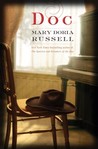
Doc


Doc
Doc by Mary Doria Russell
My rating: 3 of 5 stars

3.5 stars

Doc is a fictional retelling of the life of John Henry “Doc” Holliday, he of the gunfight at OK corral fame. It is based on family memoirs, and covers his life before the gunfight. We see his childhood in Georgia, as the son of a wealthy plantation owner, and follow him though his teens and twenties as his tuberculosis advances. This is sometimes painful to read, as we see his suffering at the hands of this horrific disease, which was incurable in those days. I felt a bit of a dark shadow over all the events, knowing the eventual outcome. (And many of the descriptions of his illness are quite graphic - not for the squeamish!)

Mary Doria Russell is a wonderful writer, and in this book she manages to capture the personalities of a myriad of characters: Doc, the Earp brothers, Kate (Doc’s mistress), and various people in the town of Dodge City, where the majority of the book takes place. I enjoyed getting a bit of background on the Earps, especially, and discovering how very different each brother was, and learning what shaped them into the men they became. Wyatt Earp is the brother that is most deeply explored, and the relationship between Doc and Wyatt is developed quite richly.

Russell has the ability to bring the “Wild West” to life, without glorifying it. Dodge City is a dirty, rowdy, dangerous mess, with politics affecting everyone who lives and visits there. Secondary characters are never simply caricatures, but are made real through little details of personality and background. Every person in this book is a fully realized person, which adds to the rich tapestry of the storyline.

All that being said, this was not as deeply moving as The Sparrow - at least for me. The book was well-researched and well-written, but it doesn’t have the philosophical depth of The Sparrow and its sequel, Children of God. Don’t get me wrong, this is a great piece of historical fiction! But it didn’t “grab” me emotionally. It may be because I held myself at a bit of a distance from Doc, because I knew he would die, and therefore was not as emotionally invested as I could have been. It certainly isn’t any fault of Russell’s writing or research. This is an excellent book - it just didn’t quite hit home for me. But for anyone who is interested in the real “Wild West” and the people who shaped it, this is a worthy addition to the genre.

Monday, November 14, 2016

Imprudence


Imprudence (The Custard Protocol, #2)Imprudence by Gail Carriger
My rating: 4 of 5 stars

This is book two of the “Custard Protocol” series by Gail Carriger. The book is set in the same universe as the “Parasol Protectorate” series and the “Finishing School” series. You don’t need to have read any of those books to enjoy this one, though the PP series is pretty much the foundation for all the other series, and if you’ve read it, you will get a bit more out of the other series. You will want to have read the first book in the series (Prudence), however, as events in that first book lead directly to events in this one.

As with all books set in this universe, there is lots of steampunk technology, plenty of detailed descriptions of attire and food (oh, the food!!), and vampires and werewolves and ghosts. And tea, one cannot forget the tea! And lots of light-hearted humor. I found the dialog in this book to be particularly sparkling, laughing out loud at several points. The action moves along quite well, and there is just enough romance to keep it interesting.

This book continues the adventure of Prudence Alessandra Maccon Akeldama (AKA “Rue”), the daughter of a werewolf, a soulless human, and a vampire. (It’s complicated.) She is the proud “Lady Captain” of The Spotted Custard, a dirigible painted like a lady bug. She and her intrepid crew have just returned from a harrowing trip to India, and events in this book send them off to Egypt and points south.

The character development continues in this book, and we learn much more about many of the other crew members. Even the secondary characters are not given short shrift - Spoo, the former sootie and now deckie, is my favorite, and I suspect I’m not alone. Even Percy, the prissy brother of Rue’s best friend, manages to develop a spine. And, of course, the romance between Rue and Quesnel, is finally acknowledged and acted upon. Oh my! (Still quite PG-13.)

For me, this book is even better than Prudence. This is Carriger at her best: witty and fun, with crisp dialog, a smattering of action, and a bit of romance. And tea. Always, tea. :-)

Friday, November 4, 2016

Kindred


KindredKindred by Octavia E. Butler
My rating: 4 of 5 stars

Quick review summary:
Part historical novel (antebellum South), part time travel mystery, Kindred is a powerful - sometimes painful - book about race, identity, and family. Masterfully written, highly recommended.

Full review:
In this book, Butler tackles slavery and race relations, cleverly woven into a time travel story. It follows the life of Dana, a young black writer, as she bewilderingly and repeatedly finds herself back in the South during the time of slavery. She gradually determines that each time she is pulled into the past, it is because a white boy (and later, a grown man) named Rufus is in danger. Somehow, she is snatched back to rescue him. The problem is, she is trapped there for an unknown length of time, and must survive at a time when most blacks were slaves. Butler gives an unflinching account of life as a slave, including several beatings and whippings. But we also see the relationships between slaves, between slave and owner, and among whites. Nothing is black and white (pardon the pun) - but there are many shades of gray in all these relationships. It is a complex society, but one that is obviously ill. Butler gives us no “Gone with the Wind” happy-go-lucky “darkies” - instead we see the physical and emotional cost of being owned by someone else, and having no ability to direct one’s life. It is a harrowing account, on all levels.

The time travel is never explained, which is fine in this story. It is clear that the link is between Dana and Rufus, and we eventually learn what ties them together. But throughout the story, Dana is at the mercy of whatever it is that pulls her back into history. She has to cope with the jarring dissonance of being a slave one moment and then being back in modern America the next. She learns to prepare for her next journey, by keeping a bag of essentials (such as aspirin) with her at all times. Her husband is also drawn into the journeys, further complicating matters. I liked that Butler never goes into the “science” of the time travel, or how it happens. It just is.

The parts of the story that take place in the past are obviously quite well researched, with many details of life as a slave, and life in general during that time period. Obviously, because slavery is involved, many of the scenes that take place in the past are difficult to read, because of the physical and emotional cruelty. But these do not overwhelm the narrative, which really focuses on the people and their relationships. It is not a simple novel, yet it reads as such, which is a credit to Butler’s skills as a storyteller.

For anyone interested in the topic of slavery and the antebellum South, this would be an essential read. I would also highly recommend it for those who enjoy time travel and the conundrums therein, as long as they don’t want to know the science behind the time travel.


Wednesday, November 2, 2016

Fledgling


FledglingFledgling by Octavia E. Butler


Quick review:
A great addition to vampire lore, with a believable type of vampire, still very sexy. Great story, fascinating characters, but bogged down slightly toward the end, which dropped it from what would have been a 5 star rating. Nevertheless, highly recommended!

Full review:
This book tells the story of Shori, a 53- year old vampire (still considered a child by other vampires), who looks like a pre-adolescent black girl. It begins with Shori awakening in a cave, horribly injured, with no memory of who she is or how she came to be injured. She begins to heal, and ventures out to find out who she is and what happened to her. A young man finds her wandering along the road, and Shori is drawn to him. She feeds briefly on his blood, and we see how very sexual this act is, both for Shori and the man. She moves in with him, and they begin to unravel the mystery of her past. The reader discovers the facts along with Shori, which makes for interesting reading. She eventually finds some of her relatives, and discovers why she is black, and what happened to her. This entire portion of the book is fast-paced, and the gradual reveal of what is going on draws the reader inexorably on. It was only in the latter third of the book, where we get into a sort of trial, that the story bogged down for me. It wasn’t terribly slow, but it was a lot of exposition, and not much action, compared to the beginning section. For this reason, it lost one star in my rating. Up until that point, it was undeniably a 5-star book.

The twist that Butler brings to vampire lore is quite interesting, and quite believable (assuming one can believe in vampires.) In this world, vampires are an ancient race, who evolved along with humans (or possibly an alien race - the vampires aren’t sure), and who have a symbiotic relationship with humans. They do not kill humans when they feed (though they could), but they gather a group of humans together and live much like a commune. The vampire feeds on a different human each night, so as not to take too much blood. The humans benefit from the vampire feedings by receiving near perfect health and a much extended life span (200 years) because of the vampire venom. Additionally, there is a psychological bond between vampire and symbiont, based on the sexual feelings aroused by feeding. Vampire and symbiont become a “family” with extremely strong bonds. The sexual nature of the relationship was done very well by Butler, along with how the “family” forms. I really like this kind of vampire, and am so sorry that Butler died before she could write any more books in what was clearly going to be a series.

This being a book by Butler, race and gender play a crucial role. By making Shori black, when all other vampires are white, brings our own racial conflict into the narrative, giving us another perspective, as all good literature should do. Giving her the appearance of a young girl brings gender and age/power roles into the mix. It’s quite a mental image to have of a pre-teen girl having sex and behaving like a grown woman. It’s a little uncomfortable, even, which I’m sure was part of what Butler wanted to achieve. The reader is forced to look at her own views on age, race, and gender.

Overall, this is a great addition to the vampire genre, and a book that any fan of the genre should read. Spectacularly well done!


Tuesday, September 13, 2016

The English Patient


The English PatientThe English Patient by Michael Ondaatje
My rating: 3 of 5 stars

I finally got around to reading this book. I, of course, first heard about it because of the movie (which I haven’t seen.) I’ve been meaning to read it ever since, and finally picked up a used copy at a second hand store this summer. And it finally made it to the top of my “to-read” list, so here we are.

First of all, I can see why so many people loved the book - it’s atmospheric and moody, and there are several love stories unfolding. But for me, it didn’t really hit home. Maybe my heartstrings are broken, but the love stories weren’t all that compelling. The only one that seemed real was the one between Kip and Hana - I was definitely rooting for their relationship to survive. The romance between the English patient and Katherine never came across as truly romantic. It could be partially because of the way it was related (through flashbacks) and maybe because the relationship itself just didn’t seem healthy. But either way, I was not engaged with that particular love story.

I did really enjoy how the book unfolds - slowly spiraling in on the events of the past that will reveal the identity of the English patient, all the while the four main characters do a similar dance around their various relationships. The style of the writing makes the book seem to be almost dream-like in quality. The mystery of the English patient’s identity was handled well - though I did figure it out before the big reveal.

The four main characters were each quite interesting in their own right. In fact, I was most drawn to the character of Kip, the Sikh who is a sapper (bomb defuser/engineer) in the British Army. Each of the other characters is physically or emotionally damaged: Hana is shell-shocked, Caravaggio has lost both thumbs, and the English patient is horribly burned and disfigured. Yet Kip seems to be quite whole in all regards. He is also the only non-white (though, curiously - and probably significantly - the English patient’s skin is nearly black due to the burn treatments he got in the desert.) As the book progresses, we learn more and more of each character’s back-story, and see how each one came to be at this particular place and time. All of the stories are interesting, and draw the reader along.

One of the biggest flaws, however, was the way the book ended. Kip’s reaction to the US dropping nuclear bombs on Japan seemed to be way out of character and a huge overreaction. Don’t get me wrong, I could see how someone like him could be that outraged, but we never saw any hint of such feelings in him at all. His reaction seemed to come out of the blue. Clearly, the author needed a reason to end Kip’s relationship with Hana, and to end the book as a whole, but this just didn’t ring true to me.

Overall, the book was pretty good. The characters and their stories were interesting, the slow unfolding of the past worked well, and the mesmerizing prose set the appropriate moody, dreamy ambience. It just didn’t have much of an emotional impact on me, personally, though I could see where others might be swept away by the romance. I’m glad I read it, if for no other reason than to know what people are talking about when it’s mentioned.

Sunday, June 26, 2016

The Black Dream


The Black Dream (Heart of the World #3)The Black Dream by Col Buchanan
My rating: 3 of 5 stars

This is the third book in the Farlander/Heart of the World series. (The previous two are Farlander and Stands a Shadow.) This is not the end of the series, FYI; I'm guessing there will be at least one more, but the author's website has no information on what's next.

The series is set in a different world than ours, but one that has many similarities, both social and geographical. The main character is Ash, a member of the Roshun (ninja-like assassins), who is dying. In the first book he takes on an apprentice, Nico, who dies at the end. Ash avenges his death, which has major political repercussions. The fallout from the vendetta makes up book two. In this third book, Ash is trying to make it to the hidden "Islands in the Sky" where it is rumored they have the ability to bring the dead back to life. He is bringing Nico's ashes in hopes of doing this.

The backdrop to the series is the "heart of the world" - a very Mediterranean-like area, dominated by the Empire of Mann (that is much like the Roman Empire at its worst.) The Empire has managed to conquer most of the countries around the sea, with only the peninsula of Khos managing to remain free - though they have been under siege for years. We follow many characters throughout the books, from all areas - the Empire, Khos, the Free Ports, etc. The author manages to keep the narrative flowing, despite the many viewpoints. It's actually quite interesting to be in the minds of so many disparate characters, and not just be following Ash all the time.

Technologically, it's a little bit steampunk, with airships and the like, but no computers. There is a kind of magic that is introduced in this book, whereby "Dreamers" can manipulate things in the real world, such as creating storms or throwing large stones. This magic is based on manipulating the "bindee" which is described as the binary code(!!) underlying everything. Some people, called rooks, can manipulate the area of the bindee that is used for long-distance communication (think hackers with the internet), which makes sense to me. But having binary code underlying objects in the real world makes me think of The Matrix movies, and hints that this world is an artificial construct inside a computer, which I don't think is the author's intent. This discrepancy is one of the books few weaknesses.

The other weakness for me is lack of a character with whom I can really identify. The other main character in this book, Shard, is a young female Dreamer/rook, who seems tailor-made for me to identify with, but even here I just don't quite connect. Ash, as the main character, is sympathetic and someone the reader can admire and root for, but I don't really connect with him, either. There are many other lesser characters, as well, who are all well fleshed-out, but there is no one to personally connect with.

However, the strength of this book (and the series) is the world-building. The author makes this world feel 100% believable. The best comparison I can make is with the Game of Thrones series, where the socio-political constructs immerse the reader in a world that seems fully real. Buchannon also does a great job with action/battle scenes. I raced through the last half of this book, pulled along by the action.

Overall, this may be the strongest book in the series, and it introduces some major new plot twists, while moving the main story toward what looks to be the inevitable showdown between the Empire and the nation of Khos.

One other caveat - this series is not for the faint of heart. It is dark, grim, and gritty. There isn't much levity at all, except maybe a little gallows humor in some characters. There are many evil, sadistic characters, and with the overall backdrop being a war of conquest, there really isn't any let up in the bad things that happen. If you're looking for a light, escapist fantasy, this ain't it! But if you enjoy complex world-building, with lots of political intrigue and action, this is your series.