Wednesday, December 14, 2016

Mary Russell's War


Mary Russell's WarMary Russell's War by Laurie R. King


3.5 stars - the stories range from 2.5-4 stars

This is a collection of short stories that fill in the gaps and add more history to the Mary Russell/Sherlock Holmes series of books by Laurie R. King (which begins with The Beekeeper's Apprentice.) All but one of these stories has been published elsewhere (including for free online) but it’s nice to have them all in one collection.

The title story was previously serialized on the author’s web site, and it follows the lead-up to, and outbreak of, WWI and its impact on a young Mary Russell and her family. It is told as a series of journal entries, often with accompanying illustrations (taken from actual newspapers of the time.) Without giving away too much, suffice it to say that extremely important events happen during this story. As such, it is a critical bit of life history for Mary Russell, and fans of the novels will be gratified to have a deeper understanding of the character.

The story titled “The Marriage of Mary Russell” is another one that fills in a gap left by the novels. At the end of A Monstrous Regiment of Women, we see Holmes propose to Russell, and her acceptance thereof. However, the next novel (A Letter of Mary) opens several years later, with the wedding a fait accompli. This delightful story gives the reader the chance to experience the wedding - which is not your normal wedding, as is to be expected by these two people!

“Beekeeping for Beginners” gives us the story of Holmes and Russell first meeting (as fully told in the first book of the series, The Beekeeper’s Apprentice), but told mostly from Holmes’ perspective. It’s quite fun to see what Holmes thought of that initial encounter, and subsequent events.

Most of the other stories only tangentially touch the novels, but all connect in some way and give fans more details of the lives of the two main characters, as well as more about some of the secondary characters - Mrs. Hudson, for example. While not every story is worth a 4-star rating, each one brings a little more depth to the characters and their history. Fans of this series will definitely want this book.


Friday, December 2, 2016

The Last Days of New Paris


The Last Days of New ParisThe Last Days of New Paris by China Miéville
My rating: 4 of 5 stars

China Miéville has an imagination that runs in overdrive, seemingly fueled by LSD or other mind-altering drugs, because his books contain some of the weirdest and most bizarre (in a good sense) ideas and plots in any fiction I’ve read. (And since I’ve been reading for over 55 years, that’s a lot of fiction!) This latest novella is a perfect example of his glorious weirdness. The fundamental plot line - that a “surrealist bomb” exploded in WWII Paris, unleashing living manifestations of surrealist art - is amazingly original and bizarre. I mean, who thinks of stuff like this?

The book opens in 1950, in “New Paris” where we are introduces to Thibault, a French freedom fighter. But what he is fighting is not just Nazis, but “manifs” - pieces of surrealist art come to life - and also demons from hell. The reader is not explicitly told these things, we simply discover them through Thibault’s experiences and memories. In this version of Paris, WWII never ended, and Paris is quarantined from the rest of the world, to keep the manifs from spreading. It is a gritty, dangerous place, and we feel Thibault’s sense of desperation and despair.

Alternate chapters flash back to 1942, where we learn about the “S-bomb” that resulted in the creation of the manifs and the opening of hell, which unleashed the demons. We get a veritable who’s who of surrealist artists and philosophers, as we see the events unfolding. (For art aficionados, there is a handy appendix that references the actual works of art that are manifesting.)

The afterword of the narrative purports to be the tale of how Miéville came to write this book - from a retelling by Thibault himself. I’m not sure that this added anything to the story for me, but it’s mildly intriguing, nonetheless.

The real brilliance of the book is the world of New Paris. The reader is immersed in its danger and its weirdness, as we follow Thibault throughout his day. Miéville makes the bizarre - living works of art - fit into the world in a cohesive whole. A weird whole, but a whole, nonetheless. You get the feeling that this could really happen, it seems so real.

Miéville is a great storyteller, and while this book doesn’t have quite the narrative depth of some of his longer works, the characters are fully realized, and the world-building is masterful. For anyone who enjoys a bit of weirdness in their fiction, this book is for you!

Thursday, December 1, 2016

Doc


Doc
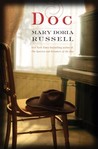
Doc by Mary Doria Russell
My rating: 3 of 5 stars

3.5 stars

Doc is a fictional retelling of the life of John Henry “Doc” Holliday, he of the gunfight at OK corral fame. It is based on family memoirs, and covers his life before the gunfight. We see his childhood in Georgia, as the son of a wealthy plantation owner, and follow him though his teens and twenties as his tuberculosis advances. This is sometimes painful to read, as we see his suffering at the hands of this horrific disease, which was incurable in those days. I felt a bit of a dark shadow over all the events, knowing the eventual outcome. (And many of the descriptions of his illness are quite graphic - not for the squeamish!)

Mary Doria Russell is a wonderful writer, and in this book she manages to capture the personalities of a myriad of characters: Doc, the Earp brothers, Kate (Doc’s mistress), and various people in the town of Dodge City, where the majority of the book takes place. I enjoyed getting a bit of background on the Earps, especially, and discovering how very different each brother was, and learning what shaped them into the men they became. Wyatt Earp is the brother that is most deeply explored, and the relationship between Doc and Wyatt is developed quite richly.

Russell has the ability to bring the “Wild West” to life, without glorifying it. Dodge City is a dirty, rowdy, dangerous mess, with politics affecting everyone who lives and visits there. Secondary characters are never simply caricatures, but are made real through little details of personality and background. Every person in this book is a fully realized person, which adds to the rich tapestry of the storyline.

All that being said, this was not as deeply moving as The Sparrow - at least for me. The book was well-researched and well-written, but it doesn’t have the philosophical depth of The Sparrow and its sequel, Children of God. Don’t get me wrong, this is a great piece of historical fiction! But it didn’t “grab” me emotionally. It may be because I held myself at a bit of a distance from Doc, because I knew he would die, and therefore was not as emotionally invested as I could have been. It certainly isn’t any fault of Russell’s writing or research. This is an excellent book - it just didn’t quite hit home for me. But for anyone who is interested in the real “Wild West” and the people who shaped it, this is a worthy addition to the genre.

Monday, November 14, 2016

Imprudence


Imprudence (The Custard Protocol, #2)Imprudence by Gail Carriger
My rating: 4 of 5 stars

This is book two of the “Custard Protocol” series by Gail Carriger. The book is set in the same universe as the “Parasol Protectorate” series and the “Finishing School” series. You don’t need to have read any of those books to enjoy this one, though the PP series is pretty much the foundation for all the other series, and if you’ve read it, you will get a bit more out of the other series. You will want to have read the first book in the series (Prudence), however, as events in that first book lead directly to events in this one.

As with all books set in this universe, there is lots of steampunk technology, plenty of detailed descriptions of attire and food (oh, the food!!), and vampires and werewolves and ghosts. And tea, one cannot forget the tea! And lots of light-hearted humor. I found the dialog in this book to be particularly sparkling, laughing out loud at several points. The action moves along quite well, and there is just enough romance to keep it interesting.

This book continues the adventure of Prudence Alessandra Maccon Akeldama (AKA “Rue”), the daughter of a werewolf, a soulless human, and a vampire. (It’s complicated.) She is the proud “Lady Captain” of The Spotted Custard, a dirigible painted like a lady bug. She and her intrepid crew have just returned from a harrowing trip to India, and events in this book send them off to Egypt and points south.

The character development continues in this book, and we learn much more about many of the other crew members. Even the secondary characters are not given short shrift - Spoo, the former sootie and now deckie, is my favorite, and I suspect I’m not alone. Even Percy, the prissy brother of Rue’s best friend, manages to develop a spine. And, of course, the romance between Rue and Quesnel, is finally acknowledged and acted upon. Oh my! (Still quite PG-13.)

For me, this book is even better than Prudence. This is Carriger at her best: witty and fun, with crisp dialog, a smattering of action, and a bit of romance. And tea. Always, tea. :-)